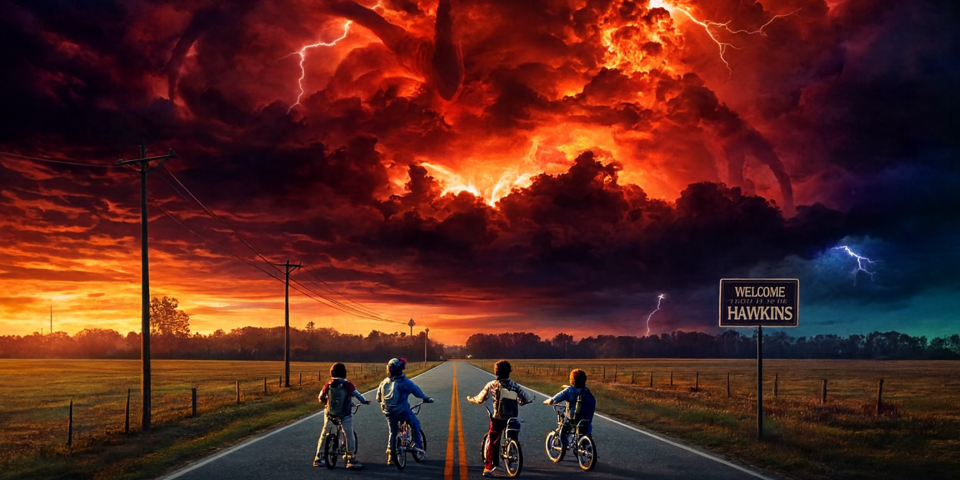
How Dustin Used Algebra to Discover the Upside Down’s Circular Wall
In Season 5, Episode 4 of Stranger Things, Dustin does something that looks like TV magic:
he places three marks on a map, draws a few lines, and suddenly realizes the Upside Down is surrounded by a perfect circle — and that he and the gang are outside of it.
It feels dramatic, but the method he uses is both mathematically valid and remarkably elegant.
This is one of the rare moments where Stranger Things leans directly into real geometry.
The Scene: A Strange Frequency From the Wall
Here’s the key dialogue that reveals what Dustin is actually doing:
Dustin: “My telemetry tracker picked up a weird frequency coming from the wall,
and it took me a bit to place, but I’ve heard it before. Rather, we have.
Remember when we were out looking for Hop, and you heard that sound off Irwin Road?”Jonathan: “Yeah. You said it was an interference.”
Dustin: “It was.
But this interference, it wasn’t coming from a military broadcast or EMI.
It was coming from this wall — which is important, because that gives us three known locations.
So, I connected the dots, measured the midpoints,
drew the perpendicular bisectors—”
This moment is everything.
Dustin literally describes the classical geometric construction for finding the circle determined by three points.
Let’s unpack it.
Three Points Are Enough to Determine a Circle
A fundamental theorem of Euclidean geometry states:
Any three non-collinear points determine a unique circle.
If the three “weird frequency” detections are points
then the circle containing them is called the circumcircle.
To find it, Dustin uses the standard geometric construction:
- Connect
– and – to form a triangle. - Find the midpoints of those two segments.
- Draw the perpendicular bisector of each segment.
- The bisectors intersect at a single point:
the circumcenter, which is the centerof the circle. - Measure the distance from
to any of the three points to get the radius .
Formally, the circumcenter
And the radius is:
These equations ensure that all three points lie on the same circle.
Dustin didn’t need to walk the entire perimeter —
three contact points are enough.
What Dustin’s Construction Means Physically
Each time the telemetry tracker picked up interference,
it meant they were exactly
Those three detections correspond to three boundary points.
Once he places them on the map, connecting the dots and constructing the perpendicular bisectors gives him:
- the shape of the wall (a circle)
- the exact center of the Upside Down boundary
- the radius
- and — most importantly — their relation to it
Step 1 — Three frequency hits
We mark the three locations where Dustin’s tracker picked up the weird interference. These are our points A, B, and C on the wall.
He realizes instantly:
They are outside the circle.
And if you are outside a circle, every direction eventually intersects it.
This is why he concludes:
- there’s no “gap”
- no open side
- no way to walk around
- the wall completely encloses the Upside Down
They are outside a closed curve.
A Real Scientific Technique (Not Sci-Fi)
What Dustin is doing mirrors how scientists determine shapes they can’t physically explore:
- GPS trilateration
- Earthquake epicenter location
- Mapping volcanic calderas
- Seismic void detection
- Astronomical orbit determination
- CT scan inverse reconstruction
In all these cases:
A few local measurements reveal a global structure.
Dustin uses three frequency detections to reconstruct an entire boundary.
The Upside Down’s wall is enormous — but the math does the walking for him.
Why This Moment Is Beautiful
Stranger Things is full of the supernatural, but this scene is pure mathematics:
- connecting three known points
- constructing perpendicular bisectors
- finding the circumcenter
- revealing a circular barrier
- and understanding its consequences
It shows a simple but deep truth:
With the right math, you don’t need to explore the whole world to understand its shape.
Sometimes three points are enough.
Three strange frequencies.
One circle.
No way around.
The algebra solves the mystery long before the characters do.