The Image of Compact Sets: A Love Letter to Continuity
When I first discovered Lean, I was captivated by the idea of machine-verified mathematics. In my journey into Lean, I learned the basics of tactics and simple proofs. Now, I want to tackle something with real mathematical depth—a theorem from my point-set topology class that I took a year and a half ago.
We used an inquiry-based learning approach in that class, which I loved. We built mathematics together, one definition and proof at a time, eventually assembling our collective work into a short book. One theorem that’s stayed with me is this beautiful result about how continuous functions preserve compactness. Let me share it with you, and in the next post, I’ll show you how to formalize it in Lean.
Setting the Stage: What is Compactness?
Before we dive into the main theorem, we need to understand what compactness means. The definition might seem technical at first, but it captures a surprisingly intuitive geometric idea.
Cover and Subcover: An indexing set
Open Cover: In a topological space
Compactness: Here’s the key definition. A subset
Think about what this means: no matter how you try to cover
A Warmup: Closed Subsets of Compact Sets
Before tackling our main theorem, let’s prove something useful: if
The Proof Idea: We start with an arbitrary open cover
This means
Now comes the punchline:
Therefore
The Main Event: Continuous Functions Preserve Compactness
Now we’re ready for the theorem that motivated this post:
Theorem: Let
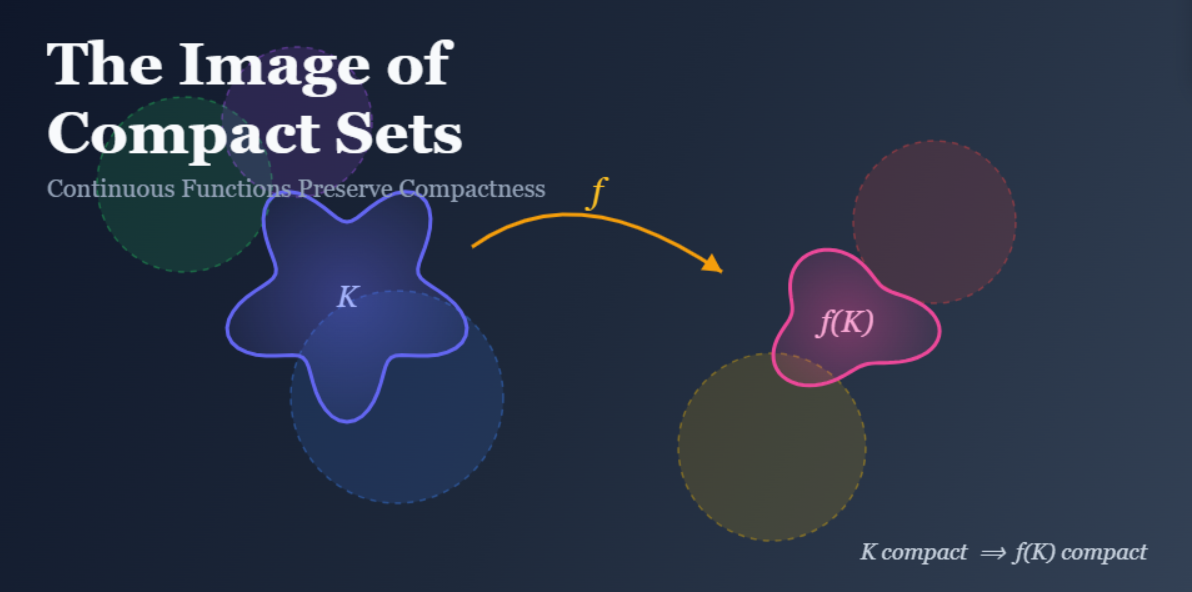
This is remarkable! Continuity is a local property—it’s about what happens in neighborhoods around points. Compactness is a global property—it’s about covers of entire sets. Yet continuous functions bridge these worlds: they take compact sets to compact sets.
The Proof Strategy: We need to show
Taking preimages (and using the fact that
Here’s where continuity enters! Since
By compactness of
Applying
Therefore
Why This Matters
This theorem is more than just a technical result. It tells us that compactness is a topological invariant under continuous maps. If you have a compact space and you continuously deform it, the image remains compact. This is why we can prove things like: the continuous image of
The proof itself is a beautiful dance between covers in the codomain and preimages in the domain, orchestrated by the continuity of
Coming Up Next
In my next post, I’ll show you how to formalize this exact proof in Lean. We’ll see how the mathematical ideas we’ve explored translate into precise, machine-verified code. It’s a natural next step in my Lean journey—moving from basic proofs to formalizing real mathematics from my coursework.
This theorem appears in the topology book my class wrote together. Special thanks to my professor and classmates for that collaborative mathematical journey.
This post is part of my series on learning Lean. Previous posts: Discovering Lean | A Mathematician’s Journey into Lean