Formalizing Compactness in Lean: From Paper to Proof Assistant
In my previous post, we explored the beautiful theorem that continuous functions preserve compactness. We worked through the proof on paper, understanding how covers in the codomain pull back to covers in the domain. Now, let’s see what happens when we formalize this mathematics in Lean 4.
This feels like a full-circle moment in my Lean journey. When I first discovered Lean, I was amazed by the very idea of machine-verified proofs. As I learned the basics, I wondered when I’d be ready to formalize real mathematics from my classes. That time is now—let’s formalize a theorem from the topology book my class wrote together!
Why Formalize Mathematics?
Before we dive in, you might wonder: why bother translating a perfectly good paper proof into code? Here are a few reasons:
- Absolute certainty: Lean checks every single step. No gaps, no “clearly we can see”, no hidden assumptions.
- Learning through precision: Formalizing forces you to understand every detail of a proof.
- Building on solid foundations: Once formalized, theorems become building blocks for more complex results, with machine-verified correctness.
- It’s actually fun: There’s something deeply satisfying about getting Lean to accept your proof.
The Lean Landscape: What’s Already There?
One of the beautiful things about Lean is its extensive mathematics library, Mathlib. Let’s see what’s already formalized that we can use:
import Mathlib.Topology.Basic
import Mathlib.Topology.Compactness.Compact

-- Topological spaces are already defined
#check TopologicalSpace

-- Continuity is defined
#check Continuous

-- Compactness is defined
#check IsCompact

-- Key lemmas we'll need
#check IsCompact.image  -- This is actually our theorem!
Wait—our theorem is already in Mathlib! It’s called IsCompact.image. But that’s perfect for our purposes: we can see how the experts did it, and we can write our own version to understand the process.
Setting Up Our Proof
Let’s start by stating the theorem in Lean. We’ll write our own version alongside the library version:
import Mathlib.Topology.Basic
import Mathlib.Topology.Compactness.Compact

-- Our theorem statement
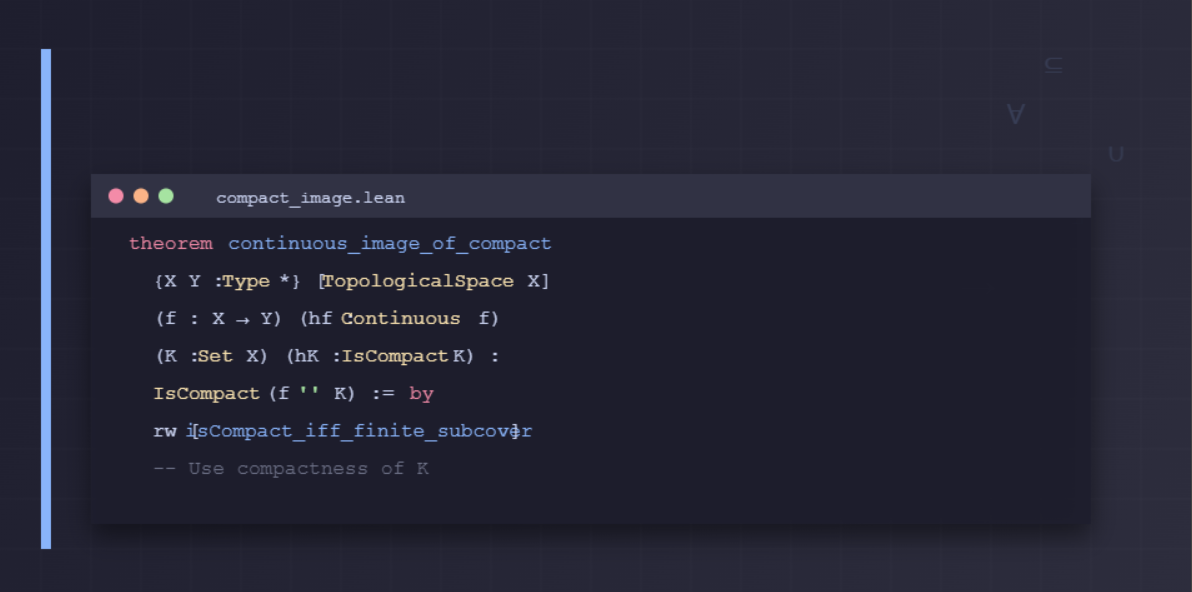
theorem continuous_image_of_compact
  {X Y : Type*} [TopologicalSpace X] [TopologicalSpace Y]
  (f : X → Y) (hf : Continuous f)
  (K : Set X) (hK : IsCompact K) :
  IsCompact (f '' K) := by
  sorry
Let’s break down this statement:
{X Y : Type*}: We have two typesand (our underlying sets) [TopologicalSpace X] [TopologicalSpace Y]: Both are equipped with topological structures (these are instances in Lean)f : X → Y: A function fromto hf : Continuous f: A proof (hypothesis) thatis continuous K : Set X: A subsetof hK : IsCompact K: A proof thatis compact IsCompact (f '' K): The conclusion that the imageis compact
The f '' K notation means the image of
Understanding Compactness in Lean
In Mathlib, IsCompact is defined in terms of filters, which is more general than the open cover definition. But there’s an equivalent characterization using open covers:
-- The open cover characterization
theorem isCompact_iff_finite_subcover {X : Type*} [TopologicalSpace X] (K : Set X) :
  IsCompact K ↔
  ∀ {ι : Type*} (U : ι → Set X),
    (∀ i, IsOpen (U i)) →
    (K ⊆ ⋃ i, U i) →
    ∃ (t : Finset ι), K ⊆ ⋃ i ∈ t, U i
This says: ι is our indexing set, U : ι → Set X is our family of open sets, and Finset ι is a finite subset of the indices.
Building the Proof: The Strategy
Our paper proof had these key steps:
- Start with an open cover of
- Pull it back via
to get an open cover of - Use compactness of
to get a finite subcover - Push forward via
to get a finite subcover of
Let’s translate this into Lean tactics:
theorem continuous_image_of_compact
  {X Y : Type*} [TopologicalSpace X] [TopologicalSpace Y]
  (f : X → Y) (hf : Continuous f)
  (K : Set X) (hK : IsCompact K) :
  IsCompact (f '' K) := by
  -- We'll use the compact_of_finite_subcover lemma
  rw [isCompact_iff_finite_subcover]
  -- Let U be an open cover of f(K)
  intro ι U hU_open hU_cover
  -- Pull back to get an open cover of K
  have preimage_cover : K ⊆ ⋃ i, f ⁻¹' (U i) := by
    intro x hx
    -- x ∈ K, so f(x) ∈ f(K)
    have : f x ∈ f '' K := ⟨x, hx, rfl⟩
    -- f(x) is in some U i by hU_cover
    obtain ⟨i, hi⟩ := hU_cover this
    -- So x is in f⁻¹(U i)
    exact ⟨i, hi⟩
  -- Each preimage is open by continuity
  have preimage_open : ∀ i, IsOpen (f ⁻¹' (U i)) := by
    intro i
    exact hf (hU_open i)
  -- Use compactness of K
  rw [isCompact_iff_finite_subcover] at hK
  obtain ⟨t, ht⟩ := hK (f ⁻¹' ∘ U) preimage_open preimage_cover
  -- t is our finite subcover
  use t
  -- Now show f(K) ⊆ ⋃ i ∈ t, U i
  intro y hy
  -- y ∈ f(K), so y = f(x) for some x ∈ K
  obtain ⟨x, hx, rfl⟩ := hy
  -- x is in some f⁻¹(U i) for i ∈ t
  obtain ⟨i, hi_mem, hi⟩ := ht hx
  -- So f(x) ∈ U i
  exact ⟨i, hi_mem, hi⟩
A Cleaner Approach: Using Mathlib Lemmas
The proof above works, but Lean’s Mathlib has many useful lemmas that make proofs shorter and more readable. Here’s a more idiomatic version:
theorem continuous_image_of_compact'
  {X Y : Type*} [TopologicalSpace X] [TopologicalSpace Y]
  (f : X → Y) (hf : Continuous f)
  (K : Set X) (hK : IsCompact K) :
  IsCompact (f '' K) := by
  -- Use the image_subset_iff lemma and properties of compact sets
  rw [isCompact_iff_finite_subcover]
  intro ι U hU_open hU_cover
  -- The preimages form an open cover of K
  have : K ⊆ ⋃ i, f ⁻¹' (U i) := by
    simpa [image_subset_iff] using hU_cover
  -- Get finite subcover using compactness
  obtain ⟨t, ht⟩ := hK.elim_finite_subcover (f ⁻¹' ∘ U)
    (fun i => hf (hU_open i)) this
  use t
  -- The images of the finite subcover still cover f(K)
  calc f '' K ⊆ f '' (⋃ i ∈ t, f ⁻¹' (U i)) := image_subset f ht
    _ ⊆ ⋃ i ∈ t, f '' (f ⁻¹' (U i)) := image_iUnion.le
    _ ⊆ ⋃ i ∈ t, U i := by
        apply iUnion₂_mono
        intro i _
        apply image_preimage_subset
The One-Liner (Because Lean is Magic)
And here’s the truth: in Mathlib, the proof is incredibly short because we have the right abstractions:
theorem continuous_image_of_compact''
  {X Y : Type*} [TopologicalSpace X] [TopologicalSpace Y]
  (f : X → Y) (hf : Continuous f)
  (K : Set X) (hK : IsCompact K) :
  IsCompact (f '' K) :=
  hK.image hf
That’s it. The .image method on compact sets takes a continuous function and produces the compactness of the image. All the work we did above is packaged into this one lemma.
What We Learn from Formalization
Formalizing this theorem taught me several things:
-
Precision matters: In the paper proof, we wrote "
" casually. In Lean, we need to think carefully about images and preimages and their properties. -
Abstraction is powerful: The filter-based definition of compactness in Mathlib is more abstract than open covers, but it enables shorter proofs and greater generality.
-
Libraries are essential: Writing proofs from absolute scratch is possible but tedious. Mathlib’s thousands of lemmas about sets, functions, and topology make formalization practical.
-
Different levels of detail: You can write explicit, step-by-step proofs (our first version), or leverage automation and high-level lemmas (the one-liner). Both have value.
Reflecting on the Journey
Looking back at where I started—first encountering Lean with simple natural number proofs—to now formalizing theorems from my topology class feels surreal. The key insight is that formalization isn’t about translating proofs mechanically; it’s about understanding mathematics at a deeper level. Every sorry you fill in, every tactic you choose, every lemma you find in Mathlib builds your mathematical intuition.
Try It Yourself!
If you want to experiment with this proof, you can:
- Install Lean 4 and set up a project with Mathlib
- Try proving related theorems, like: a closed subset of a compact set is compact (we proved this on paper in the last post!)
- Explore Mathlib’s topology files to see what else has been formalized
The journey from understanding a theorem on paper to formalizing it in Lean deepens your mathematical understanding in unexpected ways. Every step you take explicitly builds intuition about why the proof works.
Next Steps in the Series
This theorem is just the beginning. Mathlib contains formalized versions of:
- The Heine-Borel theorem
- Tychonoff’s theorem
- The extreme value theorem
- And thousands more results in topology, analysis, algebra, and beyond
The beauty of formalization is that once something is proven in Lean, it becomes a building block for everything that comes after—verified, reliable, and ready to use.
I’m excited to continue formalizing more theorems from my classes. Maybe next I’ll tackle some results from my abstract algebra course, or dive deeper into the analysis theorems I’ve been studying. If there’s a particular area of mathematics you’d like to see formalized, let me know!
Thanks to the Lean community and Mathlib contributors for building such an incredible resource. If you’re interested in learning more about Lean, check out the Lean 4 documentation and Mathematics in Lean.
This post is part of my series on learning Lean. Previous posts: Discovering Lean | A Mathematician’s Journey into Lean | The Image of Compact Sets